
Why Accurate Survey Control Matters Before High-Density Residential Redevelopment
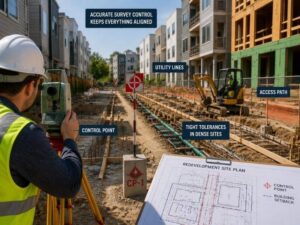
Survey control gives a high-density redevelopment the precise reference points every crew builds from. When homes sit close together and lots run tight, there’s little room for a layout error. A small slip in the reference can push a wall, a utility line or an access path into the wrong spot. So accurate control matters most exactly where space is tightest.
Dense projects pack a lot onto a little land, which raises the price of any mistake. A few inches off can force rework that ripples across the whole site and drags the schedule with it. Solid control keeps every part of the build aligned from the first stake, and that alignment holds as the project climbs.
Redevelopment often happens on lots that once held something else, so old foundations and buried lines can hide below the surface. Control points give crews a steady frame to work from even when the ground underneath holds surprises. Starting with that frame keeps the new build from inheriting the errors of whatever stood there before.
Dense Redevelopment Leaves Less Room for Layout Error
High-density sites squeeze buildings, utilities and access into a small footprint. That tight spacing means even a minor layout error can create a real conflict. A wall placed slightly off can crowd a neighbor or block a required path, and fixing it after the fact is painful.
Accurate control gives crews the tight tolerances these sites demand. Every structure lands where the plan intended, with the spacing intact. On a packed lot, that precision is the difference between a clean build and constant correction, so it earns its place early.
The math is simple on a crowded lot. When two buildings sit only a few feet apart, the space between them has no slack to absorb a mistake. Control gives crews the confidence to build right up to those tight limits without crossing them, which is exactly what dense sites ask for.
Survey Control Connects Design Plans to the Real Site
A design lives on paper until control points tie it to the actual ground. Those points let a crew translate the drawing into stakes and marks in the right places. Without them, the plan and the site drift apart, and the gap widens with every phase.
Control acts as the bridge between the designer’s intent and the builder’s work. It anchors the layout so every measurement traces back to a known reference. That connection keeps construction faithful to the approved plan, which matters most when the tolerances are narrow.
Control also protects the design intent as the project passes between teams. A plan can lose a little precision each time a new crew reads it, and small misreadings add up over the weeks. Fixed reference points hold the design steady, so the last crew on site builds to the same standard as the first.
Small Errors Can Affect Walls, Utilities and Access
On a dense site, one bad reference can throw off several systems at once. A wall built from the wrong point can crowd a utility run or narrow an access lane. Because everything sits so close, a single error rarely stays contained to one spot.
Layout mistakes on a tight site can disrupt features like these:
- Retaining or party walls set too close to a neighbor
- Utility lines routed into a conflicting position
- Access lanes narrowed below the required width
- Foundations shifted out of line with the plan
Survey Control Helps Multiple Crews Work From the Same Reference
A redevelopment brings in builders, engineers and contractors who all touch the same land. If each works from a different reference, their pieces won’t line up. Shared control points keep every crew measuring from the same base, so their work fits together.
That common reference prevents the mismatches that plague busy sites. When the utility crew and the foundation crew use identical points, their work connects as planned. Consistency across teams keeps the project moving without clashes, and it spares everyone the blame game when something doesn’t fit.
That shared base pays off most during handoffs between trades. When a plumbing crew finishes and a concrete crew moves in, both need to trust the same marks. Consistent control makes those handoffs smooth, and it stops the schedule from stalling while crews argue over whose measurement was right.
When Survey Control Should Be Established on a Redevelopment Site
Control belongs on the site before demolition, excavation, foundations or utilities begin. Setting it early means every later step measures from a trusted base. Skipping that first move invites errors that compound as the build climbs higher.
Once control is in place, each phase can proceed with confidence. Crews stake foundations and route utilities against reliable points. Establishing it first keeps the whole sequence accurate from the ground up, which is exactly what a tight site needs.
Frequently Asked Questions
What is survey control in construction?
It’s a set of fixed reference points that crews use to place work accurately across a site. Every measurement traces back to those points, which keeps the build aligned with the plan.
Why does high-density redevelopment need accurate control?
Because buildings, utilities and access sit so close together that a small error quickly turns into a conflict. Precise control gives crews the tight tolerances these packed sites require.
Can survey control reduce construction mistakes?
Yes. When every crew works from the same reliable points, their pieces line up as intended. That shared base cuts down on rework and keeps the project on track.
For a free land surveying quote, call us at (571) 200-9937 or send us a message by going here.
Posted in land surveying, land surveyor
